Showing posts with label acid rinse. Show all posts

Thursday, February 27, 2020

How to Rebuild and Restore a Victorian Tile Floor

The photos below are of a 1.7 metre by 3 metre Victorian tiled floor at the entrance to a property in Prizet, south of Kendal. As you can see the hallway and porch was in a poor state due to old age and neglect. Some tiles were cracked, missing and stained with cement, and what I suspect was carpet adhesive. One of the tiles had a four-inch hole down to the cellar where a soil pipe was installed previously when the room was used as a downstairs W.C. The client was doubtful that we would be able to restore the floor but thought it would be worth contacting us just in case.

Victorian Tiled Entrance Floor Before Rebuild Prizet Kendal Victorian Tiled Entrance Floor Before Rebuild Prizet Kendal

I visited the property to take a proper look and found their description of the floor was accurate and clearly overdue some serious attention. I also noticed that some point in the past cracked tiles had been removed and replaced with cement. However, I was confident the floor could be restored and gave them a price for the restoration which they were happy to proceed with.

Victorian Tiled Entrance Floor Before Rebuild Prizet Kendal


Repairing a Victorian Tiled Hallway Floor

Work started by rebuilding the worst part of the floor which would require the services of my partner Russell. This involved removing the existing tiles, then preparing the concrete base which needed to be level and smooth before we started tiling.

Victorian Tiled Entrance Floor During Rebuild Prizet Kendal

We had previously managed to source very similar tiles which would be needed to replace those that were missing or damaged. Once the floor was prepped, the replacements were cut to fit taking care to ensure they matched the original pattern. Once cut they were fixed in place with flexible adhesive. We recommend the use of flexible floor adhesive on old floors due to the potential movement and the flexible floor adhesive doubles up as a grout as well. The floor was then left overnight to dry.
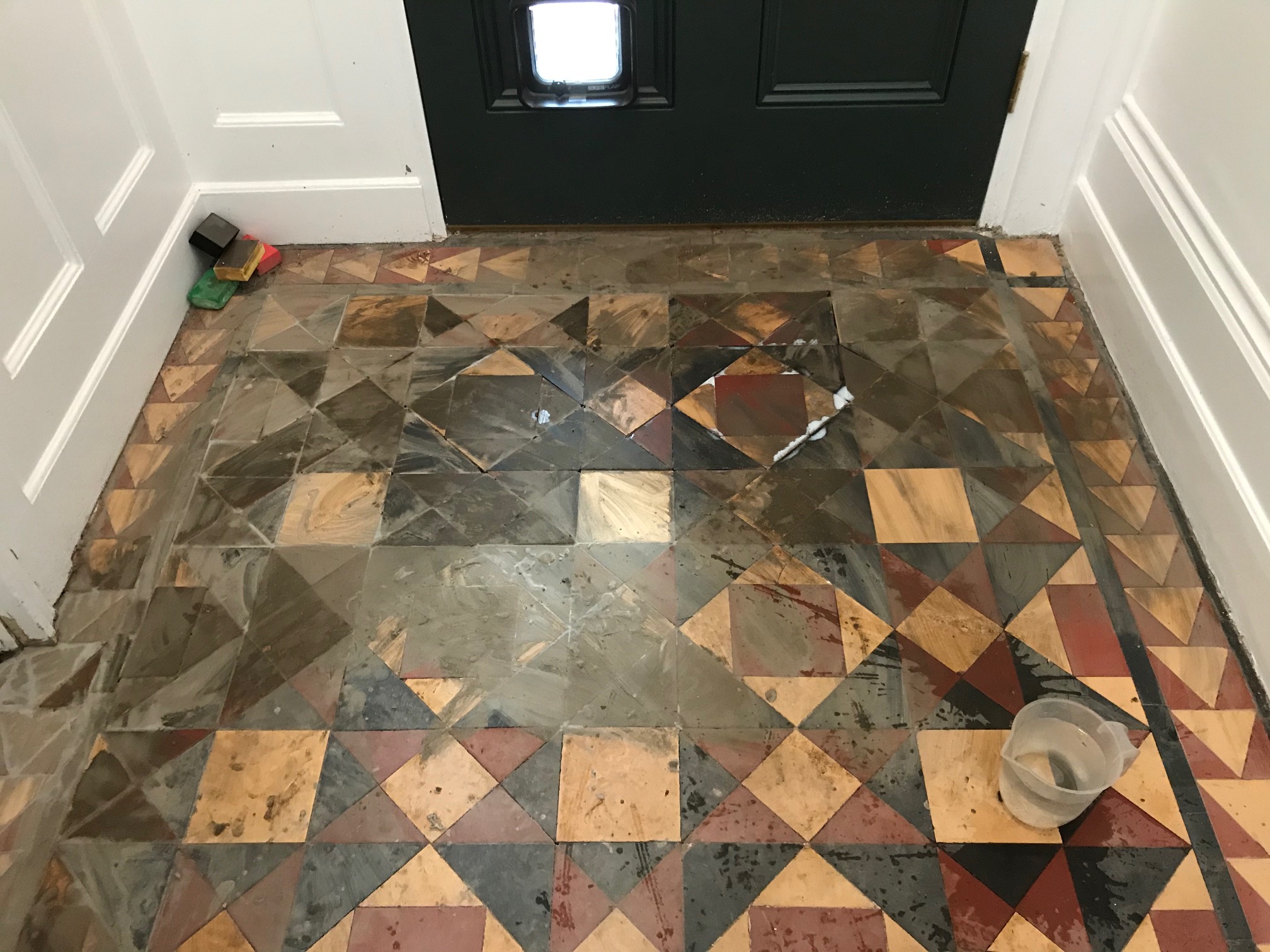
Victorian Tiled Entrance Floor During Rebuild Prizet Kendal


Deep Cleaning a Victorian Tiled Hallway Floor

On day two the floor was deep cleaned using a 100-grit resurfacing pad followed by a 200-grit pad and then a 400-grit burnishing pad. The pads are attached to a rotary machine and the floor is rinsed with water and the soil extracted with a wet vacuum in-between.

We then finished the clean with an acid rinse using Tile Doctor Grout Clean Up. This is needed to remove the cement stains from the surface of the Victorian tiles and neutralise any potential efflorescent salt issues in the tiles. Another advantage is the acid slightly etches the tiles making a better bond with the sealer.

The floor was given another rinse with water and then the wet vacuum was pressed into surface again to extract the fluids and get the floor as dry as possible before leaving for the day.


Sealing a Victorian Tiled Hallway Floor

We returned on the third day and first checked the floor was fully dry using a moisture meter. Four coats of Tile Doctor Colour Grow were applied to achieve a strong enduring seal that will cope well with the traffic coming through the entrance.

Colour Grow is a colour intensifying sealer that provides durable surface protection to the tiles, but at the same time allows the surface to breath which is important in a floor such as this where no damp proof membrane is present. The results speak for themselves I was particularly happy with the area where we had repaired the hole, it was barely noticeable.

Victorian Tiled Entrance Floor After Rebuild Prizet Kendal

Many thanks to my customer for sending over the before photos and for leaving the following testimonial.

“Great restoration job done on our Victorian hall and porch tiles including replacing broken tiles and cleaning. Now looking better than ever. Russell was very professional and knowledgeable. Nicola F. Kendal”


Source: Victorian Tiled Floor Cleaning and Restoration Service in Cumbria

Friday, August 2, 2019

How to Clean and Seal Mexican Terracotta Flooring

I have lost count of how many Terracotta tiled floors we have cleaned and sealed over the years and the one thing it has taught me is to wary of Mexican Terracotta. This type of Terracotta is extremely hard to work with, its porous and made of soft clay which has usually been badly fired. Even if you do have all the equipment, experience and the right products it can be a challenge.

Mexican Terracotta Kitchen Floor Before Cleaning Penrith

If you look at these pictures of this Mexican Terracotta floor, we recently worked on in Penrith you will see the tiles looked very dull before we cleaned them. Testing indicated there was still a sealer present however we didn’t know what type it was. Knowing what your dealing with really helps narrow down the best cleaning products to use which for Terracotta tiles tends to fall into one of three different categories.
If you have the misfortune of having had Varnish laid on top of these tiles, then the job becomes significantly harder. Because of this we have to be flexible when pricing for the work, naturally if we give a quote and we use the wrong system then not only will we be out of product but also the extra labour time to get the job right for the customer.

Mexican Terracotta Kitchen Floor Before Cleaning Penrith


Cleaning a Mexican Terracotta Tiled Kitchen Floor

On this occasion the sealer at this property in Penrith was of the more common acrylic type, so we used a combination of Tile Doctor Pro-Clean and some Tile Doctor Oxy-Gel for the stubborn areas. The products are applied to the floor and then scrubbed in using a black pad fitted to a rotary buffing machine. This releases the old sealer and dirt from the tile resulting in a slurry that is then extracted off the floor using a wet vacuum. The floor is then rinsed with water and extracted again to make sure all the soil has been removed.

Last step the cleaning is to treat the tiles to an Acid Rinse to further clean the tiles and equalise the floors pH level after the use of alkaline cleaners. We used Tile Doctor Acid Gel for this which was first scrubbed in, then rinsed with water and finally extracted as before. The floor is then rinsed down again with water to remove any trace of product and the wet vacuum used to extract as much moisture from the floor as possible so it can have a better chance of drying out overnight.


Sealing a Mexican Terracotta Tiled Kitchen Floor

We called back the next day to seal the Terracotta first checking in several areas with a damp meter that the floor was nice and dry. All was well so several coats of a Tile Doctor Seal and Go were applied to the floor for a nice mid satin finish.

Mexican Terracotta Kitchen Floor After Cleaning Penrith

The finished floor looked fantastic and was doubly improved by the grout cleaning which had responded well to the Pro-Clean. The customer was over the moon with the transformation in their floor which now looked clean and bright.

Before leaving we left the customer with a bottle of Tile Doctor Neutral cleaner for aftercare. To get the best from their Terracotta tiles it’s important that customers use the correct product for regular maintenance cleaning from the start.

Mexican Terracotta Kitchen Floor After Cleaning Penrith


Source: Terracotta Tile and Grout Cleaning and Sealing Service in Cumbria

Tuesday, August 28, 2018

Putting New Life into a Classic Victorian Tiled Hallway Floor in Swansea

I was called to a property in the Mumbles area of Swansea, one of my favourite places and in fact listed in 2018 Best Places to Live. In the UK report, The Sunday Times listed Mumbles as the best in Wales, so it is always a pleasure to visit this area.

The hallway at the property had a lovely example of a classic Victorian Tiled floor containing a very detailed pattern consisting of expensive blue square and triangular shaped tiles. The tiles were a lovely and unusual pattern and in good physical condition with no cracked or replacement tiles required. It had however, been some time since the floor was last cleaned and sealed and so they contacted me, their local Tile Doctor representative to renovate the floor for them. The owners of the house recognised that it's well worth preserving original features like Victorian tiled floors as period floors like this are in demand and add value to a property. They were therefore keen to get it back to its’ near original state.

Victorian Hallway Floor Tiles Before Cleaning The Mumbles


Cleaning/Repairing a Victorian Tiled Hallway Floor

To restore the appearance of the tiles I used a 200-Grit diamond encrusted burnishing pad to remove the dirt and restore the condition of the tiles. This is run over the floor using water to lubricate and then rinsed off with water afterwards to remove the soil that is generated. This was then followed up with a 400-Grit pad which cleans and restores the surface which is left roughened after the application of the coarse 200-grit pad. This pad is again applied with water and then the floor rinsed afterwards to remove the soiling and the water is extracted using a wet vacuum.

The next step was to acid rinse the floor using Tile Doctor Acid-Gel, this is an important step for old Victorian tiled floors which have no damp proof membrane. It neutralises any inherent salts in the floor which rise through the tile from evaporation leaving unsightly white deposits on the surface. The acid gel is left to dwell for a short time and then it is scrubbed into the tile with a deck brush and then removed using the wet vacuum, the floor was then given a final rinse to neutralise it before sealing. However, for that to happen I needed the floor to be dry so after cleaning the floor I left it to dry off overnight.


Sealing a Victorian Tiled Hallway Floor

The next day I came back to the house to seal the floor. The floor had dried out nicely due to the fine weather, I quickly did a moisture test to be sure, then I was ready to move on to the sealing process.

The Mumbles area is close to the coast, so for this project I decided to use Tile Doctor Colour Grow which being an impregnating fully breathable sealer would cope better with the salty sea air. Colour Grow is a matt finish sealer that seeps into the tile occupying the small pores and in doing so prevents dirt from becoming ingrained there, it’s also a colour enhancing product that improves the colour in the tile.

After I had finished the floor was left looking restored, fresh and the vibrantly coloured pattern shone through. The client was very happy with the end result.

Victorian Hallway Floor Tiles After Cleaning The Mumbles


Source: Victorian Tile Cleaning and Sealing Service in Swansea